
Few names appear on as many lawn mower decks as Briggs & Stratton. If you’re buying a gas mower, you’ve almost certainly seen this engine brand on Craftsman, Troy-Bilt, Snapper, Senix, and other familiar machines. The question is not whether these mowers exist — it’s which type is the right match for your lawn.
This guide explains which mower categories use Briggs & Stratton engines, what to look for in a top pick, and how to keep them running season after season.
Why Briggs & Stratton Engines Are Everywhere
Briggs & Stratton has been building small engines since 1908, and that history gives homeowners two big advantages: proven designs and a huge repair network. The official Briggs & Stratton name still appears across a wide range of residential mowers because it gives brands a dependable power plant without the premium price of some competitors.
The most useful engine features you’ll find on newer B&S-powered mowers include:
- ReadyStart® starting — no priming or choking needed; just pull the cord.
- OHV (overhead valve) design — cleaner burning, better fuel economy, and lower emissions.
- Cast iron cylinder bores — extra durability in the part that takes the most wear.
- Oil Sentry® system — automatically shuts the engine down before low oil can cause damage.
These features translate into steady torque through thick grass, fewer stalls, and less effort on a Saturday morning.

A Craftsman-style push mower with a B&S engine — one of the most common residential setups you’ll see.
Credit: www.allmachines.com
Types Of Lawn Mowers With Briggs & Stratton Engines
Briggs & Stratton engines fit into nearly every mower category, from lightweight push mowers to large riding machines.
| Mower Type | Best For | Typical Engine / Deck |
|---|---|---|
| Push mower | Small, flat lawns | 125–150cc engine, 21-inch deck |
| Self-propelled mower | Medium lawns and slopes | 140–190cc engine, 21–22-inch deck |
| Riding mower | Large properties | 15–22 HP engine, 38–46-inch deck |
| Rear-engine rider | Small lawns with easy storage needs | 10–14 HP engine, 28–34-inch deck |
Push Mowers
Push mowers are the simplest and least expensive way to get a Briggs & Stratton engine. They suit small, straightforward lawns where a heavy rider would be overkill. You supply the pushing power, while the engine handles the blade.
Look for a 140cc engine, a 21-inch steel deck, and easy height adjustments. The Senix 21-inch push mower shown below is a good example of the modern budget-friendly B&S push mower: light enough to store against a wall, powerful enough for weekly maintenance.

A Senix 21-inch push mower with a Briggs & Stratton 140cc engine.
Credit: www.walmart.com
Self-Propelled Mowers
Self-propelled mowers add a drive system, so the mower pulls itself forward while you walk behind. This makes them the sweet spot for medium-sized grass areas and for yards with a gentle slope.
When shopping for a self-propelled model, check for:
- Rear-wheel drive for better traction on hills.
- Variable ground speed so you can match the pace to the conditions.
- A 21-inch or larger cutting deck.
- Electric start or easy-pull starting.
The DeWalt gas model below is typical of this category: a 21-inch self-propelled machine with a small-engine package that handles most residential lawns without bogging down.
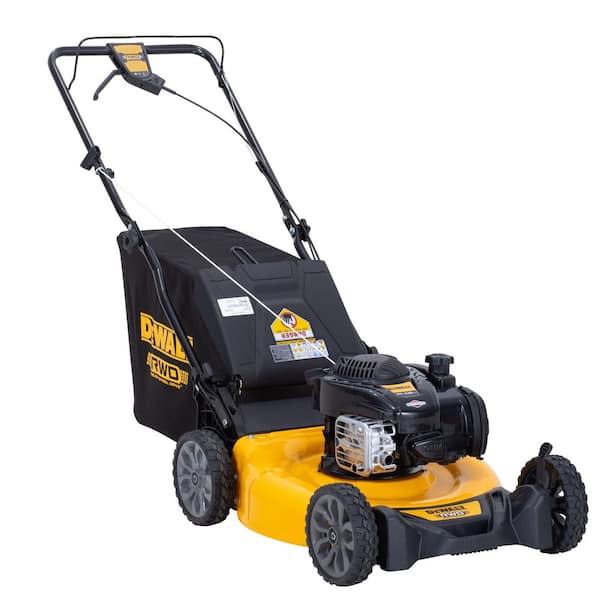
A self-propelled mower like this one lets the engine do the hard part of moving.
Credit: www.homedepot.com
Riding Mowers
Once you’re dealing with a large property, a riding mower saves hours. Many mid-range riding mowers pair a Briggs & Stratton V-twin engine with a 42-inch or 46-inch deck. That combination cuts a wide swath while keeping the controls simple enough for the whole family to use.
For flat property, flat-yard zero turns can finish the job even faster, though they cost more and demand a steadier hand on slopes.
Rear-Engine Riding Mowers
If you want seating comfort without the storage footprint of a full garden tractor, compact riding mowers are another category that frequently uses Briggs & Stratton engines. They have smaller frames, easier steering, and enough power for a quarter-acre to half-acre lot.
Top Picks By Mower Type
Briggs & Stratton produces engines of many sizes, which means a “top pick” depends more on your lawn than on the engine alone. These are the specifications worth reviewing before you buy:
| Best Pick For | Spec To Look For | Why It Works |
|---|---|---|
| Small yard | 140cc engine, 21-inch deck | Easy to push, store, and maintain |
| Medium / sloping yard | 160–190cc engine, variable speed drive | Climb hills without slowing down |
| Large yard | 17–20 HP V-twin, 42-inch deck | Wide cut and long-term durability |
| Flat yard / fast cutting | Entry-level zero-turn with B&S engine | Slashes mowing time without premium price |
Also check the starting system. ReadyStart is convenient, but electric start is worth the extra money if you have limited hand strength or prefer a one-touch ignition.
Briggs & Stratton vs Honda vs Kawasaki
Briggs & Stratton engines sit squarely between the premium price of Honda and Kawasaki and the lower-cost engines found on utility mowers. Honda engines are known for quiet operation and excellent fuel economy. Kawasaki engines dominate commercial-grade zero-turn mowers. B&S is the practical middle choice: dependable, easy to repair, and inexpensive to maintain.
That’s not a downgrade. For most homeowners, engine support matters more than peak performance. If you ever need a part, you can find it at almost any small-engine shop. If you’re comparing two mid-range riding mowers, the chassis and transmission matter just as much as the engine — the comparison of Japanese and American riders explains how similar specs can feel different in practice.
Maintenance Tips For Briggs-Powered Mowers
A Briggs & Stratton engine will run for years if you treat it to basic maintenance. The routine is not complicated:
- Check the oil level before every use.
- Change the oil at least once per season, or follow the hour interval in your owner’s manual.
- Clean or replace the air filter when it looks dirty — especially if you mow in dry, dusty conditions.
- Replace the spark plug annually.
- Use fresh fuel and add a stabilizer if the mower will sit for more than a month.
- Keep the blade sharp. A dull blade tears grass and forces the engine to work harder.
- Don’t forget regular deck cleaning to prevent wet clippings from rusting the underside.
Common Troubleshooting
| Symptom | Likely Cause | Fix |
|---|---|---|
| Hard to start | Old fuel, dirty carburetor, weak spark plug | Drain fuel, clean carburetor, replace plug |
| Runs rough | Clogged air filter or spark plug | Clean or replace both |
| Excessive smoke | Too much oil or dirty air filter | Check oil level, service filter |
| Stalls under load | Clogged deck or dull blade | Clear grass build-up, sharpen blade |
| Overheats | Grass blocking cooling fins | Clean the engine fins and outer housing |
Mowing height also affects engine load. In hot weather, raise the deck to reduce stress on both the grass and the engine. The summer mowing height should be higher than many people expect. University extension guidance recommends leaving more leaf surface to protect roots from heat and drought.
Frequently Asked Questions
Which brands use Briggs & Stratton engines in lawn mowers?
Troy-Bilt, Craftsman, Snapper, Murray, and Senix all use Briggs & Stratton engines across many models. Other brands use them in specific model lines, so check the engine badge on any mower before you buy.
Are Briggs & Stratton engines good engines?
Yes. They are well-built, easy to start, and simple to repair. They may not be as quiet as a Honda or as commercial-duty as a Kawasaki, but they are one of the most reliable choices for residential lawn care.
Do riding mowers use Briggs & Stratton engines?
Many do. Riding mowers from Craftsman, Troy-Bilt, and Snapper, as well as several rear-engine riders and entry-level zero-turns, have used B&S engines for years.
How long do Briggs & Stratton mower engines last?
With regular oil changes, clean fuel, and a sharp blade, a residential B&S engine can last many years. How long depends more on maintenance habits and the difficulty of your terrain than on the engine brand alone.
Conclusion
Briggs & Stratton engines power some of the most dependable push mowers, self-propelled mowers, and riding mowers on the market. You’ll find them in familiar brands like Craftsman, Troy-Bilt, and Snapper, plus newer names like Senix.
The engine is only half of the equation. Match the mower type to your yard size, choose the right deck width, and keep up with oil changes and air-filter service. Do that, and a Briggs & Stratton mower will make lawn care feel noticeably easier for years to come.





