
Battery-powered mowers are no longer the underpowered option in the shed. After years of steady improvement in lithium-ion batteries, brushless motors, and deck design, the 2025 model class made cordless mowing genuinely practical for the average suburban yard. If you are still asking “are battery operated lawn mowers any good?”, the honest answer is yes for many homeowners—and still no for a few specific situations.
This guide covers how they work, how they compare to gas, what to look for, and exactly who should buy one in 2026.
The Verdict Up Front
Battery mowers are good enough to be the primary mower for most yards under half an acre, especially if you value quiet, clean, and low-maintenance lawn care.
- Best for: flat or gently sloped lawns, small to medium lots, noise-sensitive neighborhoods, and anyone tired of fuel and oil.
- Not ideal for: very large properties, heavy commercial use, or lawns that are routinely overgrown and wet when you mow.
- Bottom line: the right battery mower can match gas for cut quality on a maintained lawn, as long as you match the machine to the yard.
How Battery Mowers Actually Work
A battery mower is simple under the hood. A rechargeable lithium-ion battery pack sends power to an electric motor, and the motor spins the blade. There is no carburetor, no spark plug, no air filter, and no oil to change.
The most important spec to look for is a brushless motor. Brushless motors run cooler, use less energy, and last longer than older brushed motors. They also deliver consistent torque, which means the blade keeps spinning at speed even in thicker grass.
Types of Battery Mowers
Every cordless mower fits one of a few basic formats:
| Type | Best For | Watch Out For |
|---|---|---|
| Push mower | Flat lawns under 5,000 sq ft | You supply the pushing power |
| Self-propelled | Medium lawns, slopes, older users | Heavier and uses more battery |
| Robotic mower | Frequent light mowing while you are away | Boundary setup and higher price |
| Hover mower | Uneven banks and tight corners | Less stable on open flat ground |
Performance: Where Battery Mowers Win and Lose

A modern battery mower in action: quiet, cordless, and ready at the press of a button.
Credit: www.nytimes.com
Cutting Power
Do not assume electric means weak. A good battery mower cuts cleanly through normal grass, and many 56V, 60V, and 80V models handle thick turf without bogging down.
The blade speed stays steady because there is no engine struggling to maintain RPMs. That consistency reduces torn grass blades and gives a cleaner finish than many gas mowers on routine cuts.
What battery mowers still dislike is heavy, wet, or badly overgrown grass. If you let the lawn go too long, you will hear the motor strain and watch the battery drain faster. The solution is a simple habit: mow more often, and never remove more than one-third of the grass blade at a time.
Battery Life and Charging Time
Runtime is the number one concern, and it is a fair one.
Most residential battery mowers run for 30 to 60 minutes per charge, depending on the battery capacity, blade speed, and grass conditions. Premium models with high-capacity packs can stretch beyond that, but you should plan around the worst-case session, not the best.
Charging times vary widely. A standard charger may take two hours or more, while many current fast chargers can refill an empty pack in less than an hour. That is why so many owners buy a second battery. One charges while the other mows.
The practical rule is simple: if your yard takes more than an hour with a gas mower, a single battery pack will not cover it. Budget for a second pack or look at a model that supports larger batteries in the same platform.
Terrain and Lawn Size Suitability
Battery mowers are happiest on flat and gently sloped ground. On steep slopes, the motor works harder to pull itself and the mower along, which drains the battery noticeably faster. If your property is hilly, choose a self-propelled model and a high-capacity pack.
For small lots, even an entry-level 40V mower is enough. For medium-sized yards up to half an acre, you want a self-propelled model with a 20- or 21-inch deck and a strong battery platform.
If your lawn is well over an acre and you do not want to stop for battery swaps, traditional gas mowers still cover more ground per full tank.
The Real Advantages
Quieter and Cleaner
One of the biggest surprises for first-time users is the noise level. Battery mowers are significantly quieter than gas models. You can mow early in the morning or on a weekend without annoying the whole neighborhood, and you do not need hearing protection for a small suburban lot.
They also produce zero direct emissions while mowing. The U.S. Environmental Protection Agency has long documented the air-quality impact of gasoline-powered yard equipment, and switching to electric eliminates the fumes, spills, and exhaust in your own yard.
Far Less Maintenance
A gas mower needs oil changes, spark plugs, air filters, fuel stabilizer, and carburetor attention. A battery mower needs almost none of that.
Your main jobs are keeping the blade sharp, cleaning the underside of the deck, and charging the battery. There is no fuel to go bad over winter and no pull cord to fight in the spring.
Easier Start and Storage
Starting a battery mower is a button push. There is no primer bulb, no choke, no pulling a rope twenty times. That matters more as you get older or if you hand the mower to a teenager.
Storage is better too. Most battery mowers fold into a compact shape, and many stand upright to lean against a wall. Since there is no gas tank, you can store them anywhere dry without worrying about fuel smells.
The Drawbacks You Shouldn't Ignore
Runtime Anxiety
The biggest limitation is still runtime. Battery mowers stop when the pack runs out, and that often happens at the worst possible moment.
Cold weather also hurts lithium-ion performance. If you store batteries in an unheated garage during winter, they can lose capacity and charge more slowly. Keep them indoors when temperatures drop.
Batteries also degrade over time. After hundreds of charge cycles, a pack will not hold as much charge as it did when new, and replacement packs are a real expense. Before buying any mower, check how much a spare battery costs and whether the brand is likely to keep selling that platform for years.
Higher Upfront Price
A comparable battery mower usually costs more at checkout than a gas mower with the same deck width. That price includes the battery and charger, which are the expensive parts.
The long-term math can balance out because you stop buying gas, oil, filters, and spark plugs. But if your budget is tight, the higher initial cost is still a hurdle.
Repair and Repairability
Gas mowers have been repaired by small engine shops for decades. Electric mowers need a different kind of expertise, and not every local shop will touch them.
Electronics can fail, and when they do, the repair cost may approach the price of a new mower. This is why brand reputation and warranty length matter. A longer warranty gives you more protection when something goes wrong.
Battery vs Gas Mowers: A Real-World Comparison
| Factor | Battery Mower | Gas Mower |
|---|---|---|
| Upfront price | Higher | Lower |
| Running costs | Electricity, future battery replacement | Gas, oil, filters, spark plugs |
| Maintenance | Minimal | Regular |
| Noise | Quiet | Loud |
| Direct emissions | Zero | Exhaust and fuel fumes |
| Power for thick, wet grass | Good, with limits | Excellent |
| Runtime | 30–60 minutes typical | As long as the tank lasts |
| Best role | Small to medium, maintained lawns | Large lots, tough conditions, commercial use |
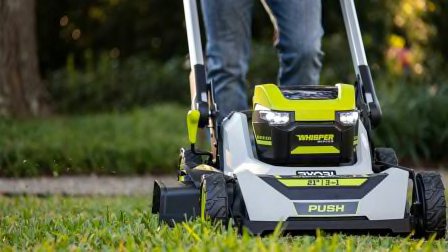
Mulching with a battery mower returns nitrogen and moisture to the soil instead of sending clippings to a landfill.
Credit: www.consumerreports.org
For a flat suburban lawn, a battery mower is now the easier, cleaner tool. For a large property with heavy grass, gas still has the edge in raw power and continuous runtime.
Top Picks From the 2025 Class
The 2025 model year was a turning point for cordless mowers, and many of those models are still sold alongside updated 2026 versions. The list below is not about one magic model; it is about matching the right battery platform to the right yard.
Best for Small Lawns
For lawns under about 5,000 square feet, a lightweight push mower with a 40V or 56V battery is more than enough. EGO’s 56V push mowers, Greenworks’ 40V lineup, and Toro’s 60V Recycler models are all solid places to start.
Do not overbuy. A self-propelled drive adds weight and drains the battery faster for no real benefit on flat, small lots. If you want a quick shortlist, our picks for compact cordless mowers are built for exactly this kind of yard.
Best for Medium to Large Lawns
For yards from about 5,000 square feet up to half an acre, look for a self-propelled mower with a 21-inch cutting deck and a battery platform that offers high-capacity packs.
EGO’s 56V self-propelled models, Ryobi’s 40V HP Brushless family, and Toro’s 60V Recycler series have all earned strong reputations. Buy a second battery if your lawn is at the larger end. You can also compare proven mid-size mower recommendations to see what fits your routine.
Best Budget Options
Entry-level battery mowers from Black+Decker, Greenworks, and Hart cost less but usually include a smaller battery and a shorter runtime. They make sense for tiny, flat lawns and first-time buyers.
Before you buy on price alone, check whether the mower can accept a larger battery from the same brand family. Being able to upgrade later makes a budget mower much smarter.
How to Choose a Battery Mower
Match the Mower to Your Lawn
Measure or estimate your lawn size honestly.
- Under 2,500 sq ft: any basic 40V mower works.
- 2,500 to 7,000 sq ft: buy a mid-voltage mower with a spare battery.
- 7,000 sq ft to half an acre: choose a self-propelled 56V/60V/80V model.
- Over half an acre: budget for multiple batteries or consider gas.
Decode the Battery Specs
Two numbers matter: voltage and amp-hours. Higher voltage generally means more power for tough cutting. Higher amp-hours means longer runtime.
If you already own a cordless tool platform from a major brand, look for a mower that shares that battery. You can buy the mower as a “tool only” and save money by using your existing packs.
Check the Cutting System
Deck width, blade design, and height adjustment matter more than horsepower in a gas engine. A 20- or 21-inch deck cuts faster across open lawn. A mower with a wide range of height settings gives you more control through the seasons.
During hot weather, raising the deck reduces stress on the grass. Follow summer mowing height recommendations to keep your lawn green when temperatures spike.
Read the Warranty
A strong warranty is one of the best signs of a reliable battery mower. Look for a multi-year warranty on the mower and a separate warranty on the battery. Battery replacement is the most common long-term cost, so make sure the brand has a real support network.
Maintaining Your Battery Mower
Battery mowers need less maintenance than gas mowers, but they are not maintenance-free. A little regular care keeps the cut clean and the battery alive for years.
Battery Care
- Charge the battery fully before first use.
- Store batteries indoors in a cool, dry place during winter.
- Avoid leaving a battery completely dead for months.
- Clean the metal contacts occasionally with a dry cloth.
- Use only the charger that matches the battery platform.
Blade and Deck Maintenance
A dull blade tears grass instead of cutting it, which turns the lawn brown and drains more battery. Sharpen the blade at least once a season, and check it after hitting rocks or roots.
Grass collecting under the deck ruins cut quality and reduces airflow. Clearing under-deck buildup after every few mows keeps the mower efficient. Never use a pressure washer directly on motor or electrical parts.
Off-Season Storage

Storing the battery separately is one of the easiest ways to prolong its lifespan between seasons.
Credit: www.cnet.com
Before winter, clean the deck, wipe down the mower, and store it in a dry place. Remove the battery and charge it to about fifty percent, then check it every couple of months.
At the start of the season, set up a spring mowing routine before the grass grows away from you. Regular cuts keep the battery mower in its comfort zone.
Frequently Asked Questions
Are battery lawn mowers good for large yards?
Not usually. Most residential models run for 30 to 60 minutes per charge, which is enough for a small or medium lawn. Large yards can be covered with multiple batteries, but you have to plan around charging breaks. For big properties, gas is still the lower-friction option.
How long do battery lawn mower batteries last?
Per charge, expect 30 to 60 minutes on most models. Over the life of the mower, a lithium-ion battery gradually loses capacity after many charge cycles, especially if it is stored in extreme heat or cold. Check replacement battery prices before you buy any cordless mower.
Do battery mowers cut as well as gas mowers?
On a regularly maintained lawn, yes. A brushless battery mower can produce a clean, even cut. Gas mowers still have an advantage in thick, wet, or overgrown grass, where the extra sustained power reduces bogging down.
Are battery mowers worth it in 2026?
For most homeowners with small to medium flat lawns, a battery mower is worth it. It is quieter, cleaner, easier to start, and far less maintenance than gas. For large acreage or commercial work, gas remains the more practical choice.
Conclusion
battery operated lawn mowers are no longer a compromise. The 2025 class proved they can cut well, run long enough for ordinary yards, and eliminate the noise, fumes, and maintenance that make gas mowers a chore.
Choose a battery mower if your lawn is small to medium, your terrain is mostly flat, and you want a simpler start to every mowing session. Choose gas if you need to cover serious acreage or you routinely fight thick, wet, and overgrown grass.
For most homeowners, the answer to “are battery operated lawn mowers any good?” is now a confident yes. Match the mower to your yard, look after the battery, and you may never want to go back to gas.





